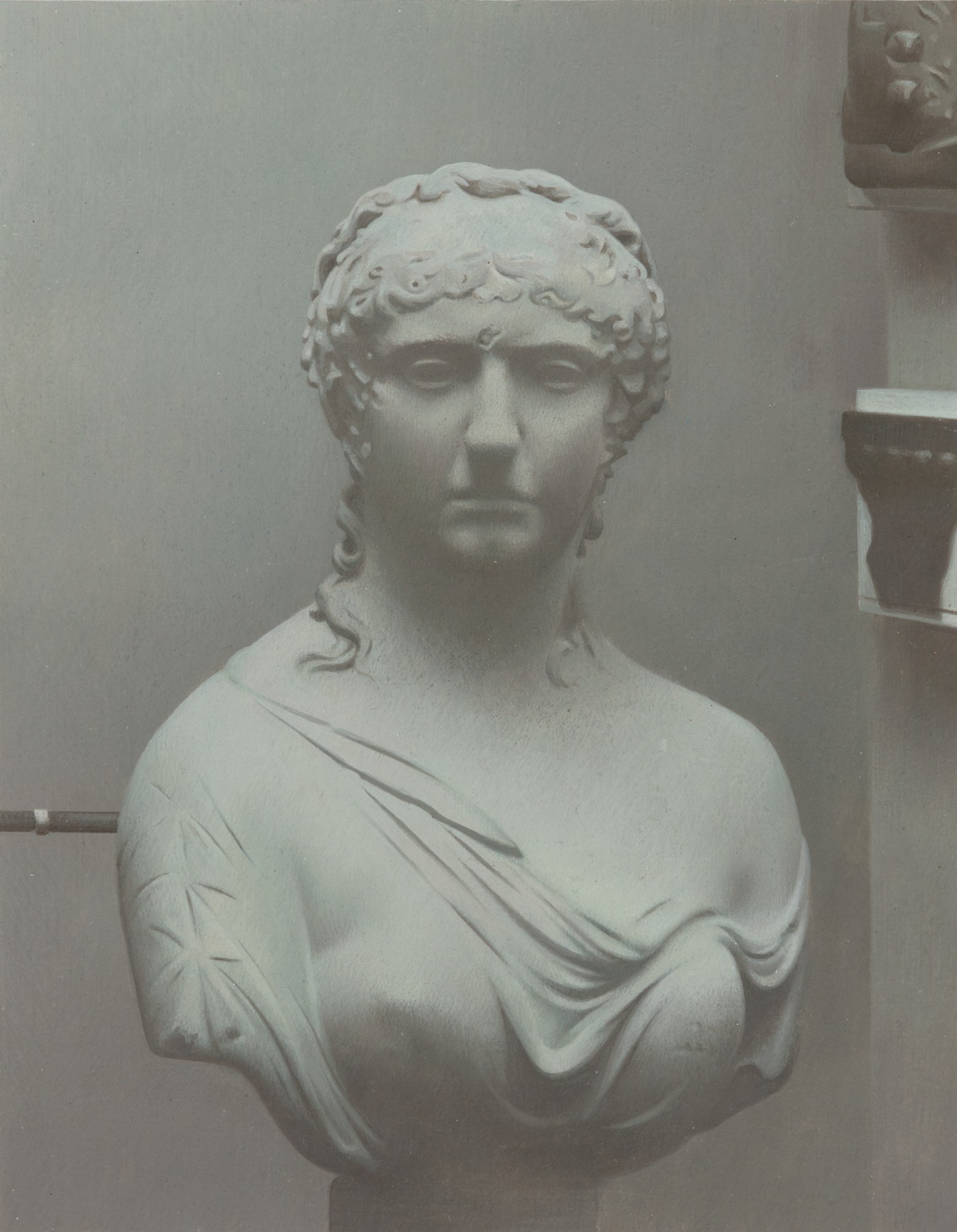
Andrew Grassie Sculpture 1, 2019
Tempera on paper on board
18,8 x 14,8 cm (image)
35,2 x 31,1 x 3 cm (framed)
The work is from a new body of work exploring images from the artist’s image archive, among them decades old snapshots associated with personal memories, tied to a specific place, a moment in time. Andrew Grassie chose motifs that had held his attention for reasons he could not always explain: photos from his image archive, sometimes many decades old and exuding a vague awkwardness, became sources for these works.
Each image of this series can be traced to a specific moment, often specific visual phenomena, remembered by the artist for personal and/or artistic reasons.
In the words of Andrew Grassie:
"I looked through my collection of photographs and came across this image I’d taken on a site visit to the Sir John Soane's Museum in London. I was scanning the museum with a view to inserting my painting into the space and had taken countless snaps of spaces and objects there. I cropped in on this Roman bust made it monochrome and played around with levels until it appeared to have this silverprint look. I was looking at old books of sculptures with black and white photos that seem so evocative in themselves and I’d wanted to try a monochrome for a while. I’d bought some special grey pigments and some pearlescent chalks to add in so I experimented with them in this painting. There is colour, I added one blue and one brown to the off whites and blacks. I don’t know if all this comes across but it was tricky to paint as the pigments were fairly transparent and took layers to build up. In this pair, exceptionally, I chose to make one image slightly larger than the other.
It’s the only one like that in the series."
The intimately scaled, precisely painted work is executed in tempera, a painting technique associated with pre-Renaissance panel paintings anteceding the development of oil paint.
Part of the conceptual premise of transforming fleeting memories captured by photographic snapshots, into unique work of art executed with a time and labor intensive traditional technique, Grassie painted this motif twice. The delicate pattern of tiny brushstrokes characteristic of tempera painting makes each image clearly unique, yet the repetition of the motifs encourages a close examination of the small differences.
Each image of this series can be traced to a specific moment, often specific visual phenomena, remembered by the artist for personal and/or artistic reasons.
In the words of Andrew Grassie:
"I looked through my collection of photographs and came across this image I’d taken on a site visit to the Sir John Soane's Museum in London. I was scanning the museum with a view to inserting my painting into the space and had taken countless snaps of spaces and objects there. I cropped in on this Roman bust made it monochrome and played around with levels until it appeared to have this silverprint look. I was looking at old books of sculptures with black and white photos that seem so evocative in themselves and I’d wanted to try a monochrome for a while. I’d bought some special grey pigments and some pearlescent chalks to add in so I experimented with them in this painting. There is colour, I added one blue and one brown to the off whites and blacks. I don’t know if all this comes across but it was tricky to paint as the pigments were fairly transparent and took layers to build up. In this pair, exceptionally, I chose to make one image slightly larger than the other.
It’s the only one like that in the series."
The intimately scaled, precisely painted work is executed in tempera, a painting technique associated with pre-Renaissance panel paintings anteceding the development of oil paint.
Part of the conceptual premise of transforming fleeting memories captured by photographic snapshots, into unique work of art executed with a time and labor intensive traditional technique, Grassie painted this motif twice. The delicate pattern of tiny brushstrokes characteristic of tempera painting makes each image clearly unique, yet the repetition of the motifs encourages a close examination of the small differences.
Scroll